Let’s make it a community!

Our first event happened on Monday night, and despite stormy weather, we had a great evening together at Armature Art Space:

IMG_2034

One thing we learned is how strongly we all feel the need to advocate for public performances. Many of us have made our own materials explaining what we do:

IMG_2058


We also recognized that New York — unlike many cities — already has many strong fans of subway performance. (They don’t always show it on their faces, but polls have repeatedly shown New Yorkers overwhelmingly supporting us, and even getting behind those controversial in-train performers!) This sure seems like the result of post-1985 legalization: if you let talented, dedicated, and generous performers do what they like for nearly 30 years, they can change the face of a city.

Nonetheless, we’d like to see New York even more visibly supportive of performers — and we’d particularly like to combat the widespread misunderstandings about subway music. Many folks support us despite thinking that we’re illicit — so let’s take a load of their backs and tell them that music is legal!

To spread the word, we’ll keep on wearing the shirts, and we’re also planning printable, crowd-sourced, customizable ads for performers’ cases. In the meantime, if you’d go out and start building community yourself — or if you’d like to make sure that the fellow musicians you see every day aren’t doing jail-time without you knowing it — you can print out your own set of BuskNY flyers designed by Kalan:

buskny2

Here’s the pdf, printable with four flyers to a page. Do you have an idea for a positive/powerful/funny/attention-grabbing/shareable poster? Share the thought with us!


Charges dropped

This is the second post in our case database series.

I would write up today’s news that the charges associated with my July 25th arrest were dropped, but there’s very little fanfare to report. When my name was called in court, I didn’t even have fifteen seconds of fame: the judge asked if I was indeed named Matthew Christian, I said I was, and she said: “alright, you’re all set.” And that was that: no paperwork, and not the least crumb of a sense that the city regrets having had me arrested for playing the violin.

There is one very important piece of take-away information from these: having video evidence of your arrest is important. In the video I took, my arresting officer insists that I’m not allowed to perform without a permit. That claim — which he used on video to justify my arrest — doesn’t hold water legal, as there is no such permit. The police flirted briefly with charges for blocking traffic, but since the police in the video had raised no concern about traffic, and since there had been no visible problem with traffic, they changed to a very dated state law concerning train stations.

The assistant district attorney handling my case could evidently see that wouldn’t fly. My Legal Aid attorney informed me a week ago that they had spoken by phone and that the charges would be dropped.

Could this case have gone differently? Sure: my arrest on 6/18 involved precisely the same circumstances, but because I didn’t take a video, I’m still charged with blocking traffic. If my arresting officer from 7/25 claimed that I was blocking traffic, it’s patently obvious that he’s lying; but if my arresting officer from 6/18 claims the same thing, it’s his word against mine. That case will be resolved tomorrow, and unfortunately, the lack of video means I’ll have to accept an ACD.


Submit your photos to the “Music is Legal” t-shirt gallery

Almost immediately after we started giving them out, we began spotting our “Music is Legal!” t-shirts all over the city. Now that we’ve managed to distribute most of this summer’s supply, we’re creating a gallery of photos performers wearing the shirts.

If you have a photo of yourself you’d like to submit, you can send it to BuskNY@gmail.com and we’ll post it in our “Music is Legal!” gallery!

We only have a few photos so far, but it would be great to see more people showing support!


Meanwhile, I’ve been working on setting up my own silkscreen equipment, so I can make even better shirts, with a new design, next year.

Also, don’t forget that our “Music is Legal” event at Armature Art Space in Bushwick is this Monday night! We hope to see you there!

Announcing our first event: “Music is Legal!” at Armature Art Space

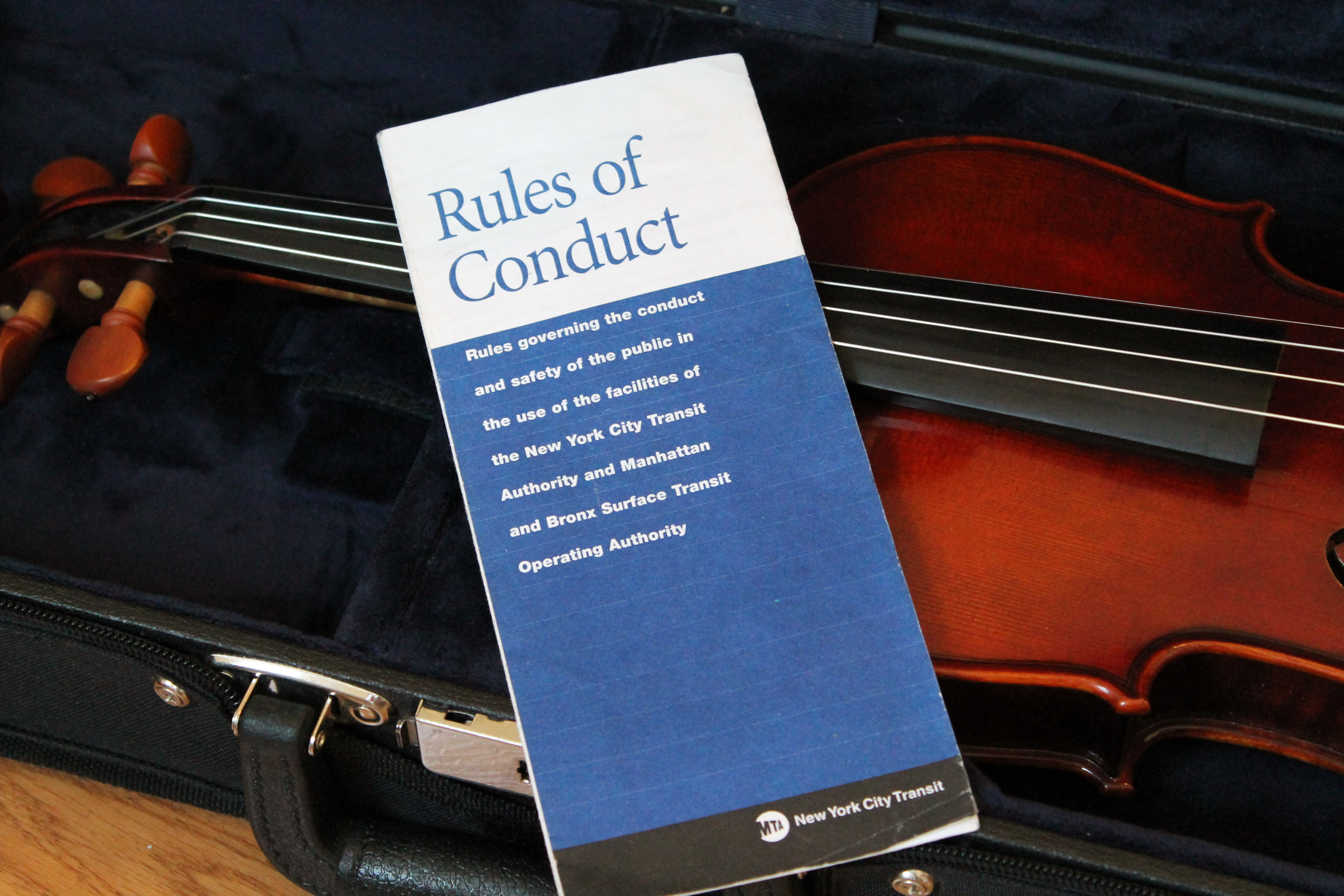
Rules of Conduct

BuskNY is pleased to announce our first community event on Monday, October 7th at Armature Art Space in Bushwick. We’re bringing together musicians and audience members to begin some community-building, and to discuss the way forward in dealing with harassment of subway performers. We’ll also be sharing updates on our own current cases and activism: stay tuned!

We’re excited to have a number of NYC subway performers meeting for the first time. And as we prepare for organizational hibernation over the winter, we want to hear from YOU what we should focus on next summer. We’re particularly keen to get everyone involved on many levels, including with advocacy, visibility, our “Music is Legal!” photo project, and spreading the word directly within the community. We look forward to seeing you there!

“Music is Legal!” at Armature Art Space
316 Weirfield St, Brooklyn, NY 11237
Monday, October 7, 9:15PM-11:30PM

Join this event on Facebook!

Follow Armature Art space’s page on Facebook for updates on future events (including an exhibition of my paintings sometime early next year!)

86th St: meet the station agent who has everyone arrested

I got a tip from a performer recently about a problem at 86th and Broadway. He was able to be quite specific about the problem: apparently, the station agent on the weekday afternoon shifts calls police every time she hears music, which has led to a number of arrests.

I made a trip up there today to see what the problem was. The station agent was very forthcoming about having called the police because of music on the platform. I showed her a copy of the rules, which she said she had never seen before. After a careful reading of the section about permitted non-transit activities, she said she now shared my opinion, but that she would still call her supervisor when she heard music. (According to her, station agents are trained to call their supervisors whenever they hear music. Fact or fiction? Maybe FOIL can tell us).

At this point, I asked her to confirm her claim with the Music Under New York office at the MTA. Surprise, she said: she is only able to call her supervisor and no one else. She did, however, agree to “call someone” to “come sort this out.”

After a fifteen minute wait, who arrived but a police officer. I showed her the rules pamphlet and she agreed that I’d be okay playing in the station. (She did ask why I had taken a picture of the station agent’s badge, which is required to be displayed in window of every station booth. Apparently the station agent had complained, in her call to the police, that a member of the public had dared record her badge number. I’m sure the MTA will love to hear that an employee was retaliating for having her badge number recorded.)

The police officer then went into the station booth to speak with the station agent for a few minutes. When she came back out, she had changed her opinion: it’s not okay to play on the platform, she said, but only on the mezzanine and only with a “license.”

I then showed her the pamphlet again, and provided the MUNY phone number so that she could confirm that no license was needed. She was convinced regarding MUNY, but seemed to think that the sections mentioning noise and blocking traffic provided a blanket justification for arresting and jailing any performer who ever performs on 86th St between the hours of 1 and 9 PM.

There was only one thing to do at that point. I pulled out a copy of the settlement notice from my lawsuit and told her that the last police officer to share her opinion cost the City of New York thirty thousand dollars. That made her doubt herself again. She said she would check with her sergeant about the rules, and invited me in to the 59th St precinct to discuss the matter further.

The only problem there? Well, the sergeant in question once threw me out of 59th St for daring to show him a copy of the rules (itself currently the topic of a CCRB investigation). So I doubt that the issue will get a fair hearing — at least, that is, until my two arrests from this summer cause some lawsuits to land at the 59th St doorstep.

And as far as the station agent goes? I’ll be filing a complaint shortly about the badge number reprisal and the harassment of performers. Given that my complaint about harassment at 81st generated a personal phone call and a promise to speak with the employee in question, I have high hopes. 86th St, we’ll bring the music back yet!

Disobeying: letter from the front lines

I recently got this email from a friend and fellow performer about an incident at the 53rd St mezzanine. I immediately knew I had to share it, not for the nice things she says about our work, but because her description of what’s involved emotionally in standing up to a wrongful order from a police officer is spot-on. I’ve been in her shoes, I know how scary this is, and I’m glad she got it on paper:

“Just a note to let you know how empowered [BuskNY] makes buskers feel. At one time we had no one to stand along with us when we were harassed by policemen.

I had an incident tonight that went over pretty well.  Once again, I was singing at 53rd Lexington, (Upstairs on the mezzanine where MUNY performers are scheduled). This is the exact same place I received the first ticket and summons.  Well, to make a long story short, everything was going quite nicely until an officer walked up to me and said, “You have five more minutes and then you wrap it up. I’m at this station now.”  My response was why did I have to leave.  He told me it was because I did not have a permit. I then informed him that I had a right to perform on that mezzanine without a permit and that Tim Higginbotham of MUNY told me to contact him whenever a policeman approached me about that location.  Well, the officer did not want to hear it and told me when he came back he wanted me to be gone. I told him I had the same problem with Officer Valdez because he was not informed that performers had a right to play at that station. I told him that if I were to be ticketed that I would sue this time.  He said, “do what you want but you have to leave.”

I was so angry but I thought about my equipment. A performer told me that the police took his equipment away from him and he never got it  back. But as I began packing up I thought about BuskNY and suddenly felt empowered. I refused to leave. I continued singing. All the while I imagined officers around me, handcuffing and taking me away. Yes, I was prepared for that. I had made up my mind that no matter what the officer or officers said to me that I was going to ignore them and just keep singing.

After about an hour, the officer came back upstairs, saw me singing and walked past me mumbling, “you’ve been here well over an hour now.”  BUT he did not bother me. I think it helped when I called the officer’s name that ticketed me the first time but also…I made sure to tell him that I was going to put in a lawsuit. I felt it was something I was able to do easily with BuskNY.

I just wanted to share this story with you and let you know once again how wonderful it is to know that someone and something ‘has your back’ as a performer. It’s tough enough giving the best you have of your talent while most people just walk past you without giving what you do a thought, less lone being hassled by policemen.  Your courage has given me courage.”

Performers are wrongfully ordered around by police every day in this city, and standing up to that problem means putting our equipment, our livelihood, our physical freedom, and our safety on the line. It’s scary, it’s very real, and it’s just not going to happen if no one has performers’ backs with legal tips, paperwork, model cases, and moral support. For one, I’m glad we’re doing the work we do.

Working with the MTA: accountability for station agents

Summary:

Station agents often wrongfully call police on performers. If police tell you they were called by a station agent, or simply that they “got a call,” you can assert your right to perform. But also, you have the option of reporting the station agent. To do so, record the number on the badge displayed in the booth window. Then, call 511 and leave a clear complaint stating what occurred. The MTA will follow up with you by mail to consult about retraining — and you have created an official record that will protect future buskers in that station.

Are station agents ever responsible for the arrival of the police? And can we effect change by working with the MTA to address harassment that arises from station agents’ misunderstandings of the rules? That’s a question that most of us don’t think to ask — and indeed, it seems that the police most often get involved with performers of their own accord, when they really should be doing other things.

However, it may be that station agents do request police interventions more often than we realize. After all, when the police throw you out, you have to get right out — which precludes going to the booth to find out from the station agent if there were factually any concerns about noise or traffic. (It also keeps you from filing any complaints, and we’ve written before about being ejected precludes any documentation of the harassment). So really, a performer who’s ejected has no way to know if a complaint was made by the station agent at all, unless he or she risks arrest by disobeying an officer’s order to stay out.

I had the rare opportunity to find out directly about a station agent’s involvement on August 1. As I wrote in a post about that incident, I showed the officers a copy of the rules, and after reading them, they agreed that there was no reason for me to cease the performance.

I haven’t yet shared information about the next part. Once the officers had left, I went to the station agent and asked if she knew why the police had come. To my considerable surprise, she told me right up front that she had called them, apparently in response to a customer complaint. “And you know that performing here is legal?” I asked. “Well, I had to call, because it was a customer complaint,” she replied. I found this a bit unsatisfactory, and asked her if she would call the police if told by a customer that there was a train in the train station. She replied that she wouldn’t, but that she did feel obliged to call to report a musician.

I didn’t find that answer acceptable. So, I took down her badge number and immediately dialed the MTA at 511 to file a complaint. I told them that the police had been called to ask me to stop performing, and that the police themselves had refused to enforce that order. I explained the law to them briefly, and asked if they could look into why the station agent had called the police to report an activity permitted by the MTA.

Well, lo and behold, I got a call this week from the 81st St manager, who is looking into the complaint. I told her in no uncertain terms that she should find out what’s going on with this station agent. When she didn’t immediately sound convinced, I mentioned that wrongful arrests have begun to cost the city through the nose — and indeed, she sounded receptive to that point.

When I arrived home today from Boston, I had a follow-up letter from the MTA. It read:

“This is in response to your August 1 telephone call to MTA New York City Transit reporting a station agent at the 81st Street station.

We regret if you experienced any difficulty while using the subway system. We have forwarded your complaint to supervision in our Department of Subways for review. Based on the information you provided, we hope to identify this station agent for questioning and appropriate action.”

I’m pleased to know that the MTA is looking into this. It doesn’t make sense for their staff to be enforcing rules that don’t exist, and they’re handling the problem the right way.

But, they’ll only be able to do that if we let them know about harassment stemming from station agents, and that means doing some sleuthing ourselves. If you’re ever harassed within a station, given a summons, asked to leave, or arrested, make sure you follow up on it with the station agent. Even if it’s the next day, you can likely find out who the person was and obtain a badge number. If you get confirmation that the station agent called the police — particularly if there’s a known problem with harassment, as there is at 81st St — you should call up 511 and report it.

The MTA’s willing to work with us on this one. And every time we advocate for discussion and training, we have the change to make a ‘harassment station’ into a safe station. That’s what we call change for the better in NYC!

Case update

Update: I just happened upon this excellent article on the geographic distribution of NYC summons charges. The author describes the use of “disorderly conduct charges …  as a kind of policing panacea — a catch-all charge officers can use against behavior they don’t like.” That’s something we’ve seen too — and when it’s so difficult to have charges dismissed in a timely manner, it’s no wonder that the NYPD isn’t pushed to act lawfully.

Many of you know that I was in Manhattan Criminal Court on Monday and Tuesday. I had been hoping to post an update immediately afterwards with good news, but unfortunately, that didn’t prove to be the case.

On the other hand, it’s not bad news per se. In a nutshell, the only thing that happened was that the courts kicked my two cases down the road a month. Somewhat of a letdown when you’re thinking in terms of right, wrong, and resolution, huh?

In more detail, the situation is this. I’ve been offered an Adjournment in Contemplation of Dismissal, or for the initiated, an ACD. That’s an agreement in which the charges are dropped after six months with no admission of guilt, provided that you don’t rob any banks in the meantime.

Now, the Powers that Be would very much like for me to take an ACD. It wouldn’t be the worst thing in the world to do so: I would still be able to sue over the arrests, and the arrest charges would be sealed. However, I’m a stickler for, y’know, not accepting things involving ‘adjournment’ or ‘contemplation’ when I’ve been arrested for something that is, last time we all checked, specifically okayed by the MTA Rules of Conduct.

Once you’ve turned down the ACD, though, it turns out to be awfully hard to actually get a trial. The prosecution now has a thirty day period to prepare its case for trial, meaning that I’ve been given new appearance dates on October 7th and 8th. In the meantime, various things will be happening that could suspend or set back that thirty day period. (Side note: why the prosecution did not start preparing its case after I turned down the ACD the first time on June 18th is beyond me.)

All of the delays mean that ultimately, I’m likely to show up and be offered another adjournment – and if that adjournment date is after October 14th, I will already have left on my Fulbright grant to Senegal. So if the case is adjourned again, I’ll be forced to take the ACD and waive my right to a trial.

I imagine it’s clear why this was something of a disappointment. I earnestly don’t think it should be so naive to envision having a trial date within four months of an arrest.

Case closed: disorderly traffic summons

This is the first post in our case database. Hoping it grows, to give performers more information about dealing with legal threats in the future.

We had some good news in court today — not for me, but for a friend. She had been issued a pink summons for playing the guitar and singing at 53rd St. Once again, the charge didn’t fit the crime artistic performance: she was facing §240.20, ‘Disorderly Conduct.’ The statute reads:

A person is guilty of disorderly conduct when, with intent to cause public inconvenience, annoyance or alarm, or recklessly creating a risk thereof:
[…]
5. He obstructs vehicular or pedestrian traffic.

Of course, it could have been worse: she could have been charged with section 7, “[creating] a hazardous or physically offensive condition by any act which serves no legitimate purpose.” These laws are so hurtful!

On a more serious note, she went in for her court date and reports having had the charges immediately dropped. So that’s a victory for sanity, for music, and for culture. Cheers, all!