86th St: meet the station agent who has everyone arrested

I got a tip from a performer recently about a problem at 86th and Broadway. He was able to be quite specific about the problem: apparently, the station agent on the weekday afternoon shifts calls police every time she hears music, which has led to a number of arrests.

I made a trip up there today to see what the problem was. The station agent was very forthcoming about having called the police because of music on the platform. I showed her a copy of the rules, which she said she had never seen before. After a careful reading of the section about permitted non-transit activities, she said she now shared my opinion, but that she would still call her supervisor when she heard music. (According to her, station agents are trained to call their supervisors whenever they hear music. Fact or fiction? Maybe FOIL can tell us).

At this point, I asked her to confirm her claim with the Music Under New York office at the MTA. Surprise, she said: she is only able to call her supervisor and no one else. She did, however, agree to “call someone” to “come sort this out.”

After a fifteen minute wait, who arrived but a police officer. I showed her the rules pamphlet and she agreed that I’d be okay playing in the station. (She did ask why I had taken a picture of the station agent’s badge, which is required to be displayed in window of every station booth. Apparently the station agent had complained, in her call to the police, that a member of the public had dared record her badge number. I’m sure the MTA will love to hear that an employee was retaliating for having her badge number recorded.)

The police officer then went into the station booth to speak with the station agent for a few minutes. When she came back out, she had changed her opinion: it’s not okay to play on the platform, she said, but only on the mezzanine and only with a “license.”

I then showed her the pamphlet again, and provided the MUNY phone number so that she could confirm that no license was needed. She was convinced regarding MUNY, but seemed to think that the sections mentioning noise and blocking traffic provided a blanket justification for arresting and jailing any performer who ever performs on 86th St between the hours of 1 and 9 PM.

There was only one thing to do at that point. I pulled out a copy of the settlement notice from my lawsuit and told her that the last police officer to share her opinion cost the City of New York thirty thousand dollars. That made her doubt herself again. She said she would check with her sergeant about the rules, and invited me in to the 59th St precinct to discuss the matter further.

The only problem there? Well, the sergeant in question once threw me out of 59th St for daring to show him a copy of the rules (itself currently the topic of a CCRB investigation). So I doubt that the issue will get a fair hearing — at least, that is, until my two arrests from this summer cause some lawsuits to land at the 59th St doorstep.

And as far as the station agent goes? I’ll be filing a complaint shortly about the badge number reprisal and the harassment of performers. Given that my complaint about harassment at 81st generated a personal phone call and a promise to speak with the employee in question, I have high hopes. 86th St, we’ll bring the music back yet!

Disobeying: letter from the front lines

I recently got this email from a friend and fellow performer about an incident at the 53rd St mezzanine. I immediately knew I had to share it, not for the nice things she says about our work, but because her description of what’s involved emotionally in standing up to a wrongful order from a police officer is spot-on. I’ve been in her shoes, I know how scary this is, and I’m glad she got it on paper:

“Just a note to let you know how empowered [BuskNY] makes buskers feel. At one time we had no one to stand along with us when we were harassed by policemen.

I had an incident tonight that went over pretty well.  Once again, I was singing at 53rd Lexington, (Upstairs on the mezzanine where MUNY performers are scheduled). This is the exact same place I received the first ticket and summons.  Well, to make a long story short, everything was going quite nicely until an officer walked up to me and said, “You have five more minutes and then you wrap it up. I’m at this station now.”  My response was why did I have to leave.  He told me it was because I did not have a permit. I then informed him that I had a right to perform on that mezzanine without a permit and that Tim Higginbotham of MUNY told me to contact him whenever a policeman approached me about that location.  Well, the officer did not want to hear it and told me when he came back he wanted me to be gone. I told him I had the same problem with Officer Valdez because he was not informed that performers had a right to play at that station. I told him that if I were to be ticketed that I would sue this time.  He said, “do what you want but you have to leave.”

I was so angry but I thought about my equipment. A performer told me that the police took his equipment away from him and he never got it  back. But as I began packing up I thought about BuskNY and suddenly felt empowered. I refused to leave. I continued singing. All the while I imagined officers around me, handcuffing and taking me away. Yes, I was prepared for that. I had made up my mind that no matter what the officer or officers said to me that I was going to ignore them and just keep singing.

After about an hour, the officer came back upstairs, saw me singing and walked past me mumbling, “you’ve been here well over an hour now.”  BUT he did not bother me. I think it helped when I called the officer’s name that ticketed me the first time but also…I made sure to tell him that I was going to put in a lawsuit. I felt it was something I was able to do easily with BuskNY.

I just wanted to share this story with you and let you know once again how wonderful it is to know that someone and something ‘has your back’ as a performer. It’s tough enough giving the best you have of your talent while most people just walk past you without giving what you do a thought, less lone being hassled by policemen.  Your courage has given me courage.”

Performers are wrongfully ordered around by police every day in this city, and standing up to that problem means putting our equipment, our livelihood, our physical freedom, and our safety on the line. It’s scary, it’s very real, and it’s just not going to happen if no one has performers’ backs with legal tips, paperwork, model cases, and moral support. For one, I’m glad we’re doing the work we do.

Working with the MTA: accountability for station agents

Summary:

Station agents often wrongfully call police on performers. If police tell you they were called by a station agent, or simply that they “got a call,” you can assert your right to perform. But also, you have the option of reporting the station agent. To do so, record the number on the badge displayed in the booth window. Then, call 511 and leave a clear complaint stating what occurred. The MTA will follow up with you by mail to consult about retraining — and you have created an official record that will protect future buskers in that station.

Are station agents ever responsible for the arrival of the police? And can we effect change by working with the MTA to address harassment that arises from station agents’ misunderstandings of the rules? That’s a question that most of us don’t think to ask — and indeed, it seems that the police most often get involved with performers of their own accord, when they really should be doing other things.

However, it may be that station agents do request police interventions more often than we realize. After all, when the police throw you out, you have to get right out — which precludes going to the booth to find out from the station agent if there were factually any concerns about noise or traffic. (It also keeps you from filing any complaints, and we’ve written before about being ejected precludes any documentation of the harassment). So really, a performer who’s ejected has no way to know if a complaint was made by the station agent at all, unless he or she risks arrest by disobeying an officer’s order to stay out.

I had the rare opportunity to find out directly about a station agent’s involvement on August 1. As I wrote in a post about that incident, I showed the officers a copy of the rules, and after reading them, they agreed that there was no reason for me to cease the performance.

I haven’t yet shared information about the next part. Once the officers had left, I went to the station agent and asked if she knew why the police had come. To my considerable surprise, she told me right up front that she had called them, apparently in response to a customer complaint. “And you know that performing here is legal?” I asked. “Well, I had to call, because it was a customer complaint,” she replied. I found this a bit unsatisfactory, and asked her if she would call the police if told by a customer that there was a train in the train station. She replied that she wouldn’t, but that she did feel obliged to call to report a musician.

I didn’t find that answer acceptable. So, I took down her badge number and immediately dialed the MTA at 511 to file a complaint. I told them that the police had been called to ask me to stop performing, and that the police themselves had refused to enforce that order. I explained the law to them briefly, and asked if they could look into why the station agent had called the police to report an activity permitted by the MTA.

Well, lo and behold, I got a call this week from the 81st St manager, who is looking into the complaint. I told her in no uncertain terms that she should find out what’s going on with this station agent. When she didn’t immediately sound convinced, I mentioned that wrongful arrests have begun to cost the city through the nose — and indeed, she sounded receptive to that point.

When I arrived home today from Boston, I had a follow-up letter from the MTA. It read:

“This is in response to your August 1 telephone call to MTA New York City Transit reporting a station agent at the 81st Street station.

We regret if you experienced any difficulty while using the subway system. We have forwarded your complaint to supervision in our Department of Subways for review. Based on the information you provided, we hope to identify this station agent for questioning and appropriate action.”

I’m pleased to know that the MTA is looking into this. It doesn’t make sense for their staff to be enforcing rules that don’t exist, and they’re handling the problem the right way.

But, they’ll only be able to do that if we let them know about harassment stemming from station agents, and that means doing some sleuthing ourselves. If you’re ever harassed within a station, given a summons, asked to leave, or arrested, make sure you follow up on it with the station agent. Even if it’s the next day, you can likely find out who the person was and obtain a badge number. If you get confirmation that the station agent called the police — particularly if there’s a known problem with harassment, as there is at 81st St — you should call up 511 and report it.

The MTA’s willing to work with us on this one. And every time we advocate for discussion and training, we have the change to make a ‘harassment station’ into a safe station. That’s what we call change for the better in NYC!

Case update

Update: I just happened upon this excellent article on the geographic distribution of NYC summons charges. The author describes the use of “disorderly conduct charges …  as a kind of policing panacea — a catch-all charge officers can use against behavior they don’t like.” That’s something we’ve seen too — and when it’s so difficult to have charges dismissed in a timely manner, it’s no wonder that the NYPD isn’t pushed to act lawfully.

Many of you know that I was in Manhattan Criminal Court on Monday and Tuesday. I had been hoping to post an update immediately afterwards with good news, but unfortunately, that didn’t prove to be the case.

On the other hand, it’s not bad news per se. In a nutshell, the only thing that happened was that the courts kicked my two cases down the road a month. Somewhat of a letdown when you’re thinking in terms of right, wrong, and resolution, huh?

In more detail, the situation is this. I’ve been offered an Adjournment in Contemplation of Dismissal, or for the initiated, an ACD. That’s an agreement in which the charges are dropped after six months with no admission of guilt, provided that you don’t rob any banks in the meantime.

Now, the Powers that Be would very much like for me to take an ACD. It wouldn’t be the worst thing in the world to do so: I would still be able to sue over the arrests, and the arrest charges would be sealed. However, I’m a stickler for, y’know, not accepting things involving ‘adjournment’ or ‘contemplation’ when I’ve been arrested for something that is, last time we all checked, specifically okayed by the MTA Rules of Conduct.

Once you’ve turned down the ACD, though, it turns out to be awfully hard to actually get a trial. The prosecution now has a thirty day period to prepare its case for trial, meaning that I’ve been given new appearance dates on October 7th and 8th. In the meantime, various things will be happening that could suspend or set back that thirty day period. (Side note: why the prosecution did not start preparing its case after I turned down the ACD the first time on June 18th is beyond me.)

All of the delays mean that ultimately, I’m likely to show up and be offered another adjournment – and if that adjournment date is after October 14th, I will already have left on my Fulbright grant to Senegal. So if the case is adjourned again, I’ll be forced to take the ACD and waive my right to a trial.

I imagine it’s clear why this was something of a disappointment. I earnestly don’t think it should be so naive to envision having a trial date within four months of an arrest.

Case closed: disorderly traffic summons

This is the first post in our case database. Hoping it grows, to give performers more information about dealing with legal threats in the future.

We had some good news in court today — not for me, but for a friend. She had been issued a pink summons for playing the guitar and singing at 53rd St. Once again, the charge didn’t fit the crime artistic performance: she was facing §240.20, ‘Disorderly Conduct.’ The statute reads:

A person is guilty of disorderly conduct when, with intent to cause public inconvenience, annoyance or alarm, or recklessly creating a risk thereof:
[…]
5. He obstructs vehicular or pedestrian traffic.

Of course, it could have been worse: she could have been charged with section 7, “[creating] a hazardous or physically offensive condition by any act which serves no legitimate purpose.” These laws are so hurtful!

On a more serious note, she went in for her court date and reports having had the charges immediately dropped. So that’s a victory for sanity, for music, and for culture. Cheers, all!

Cheerios, and how I was depicted

I’ve gotten out of the habit of posting busking updates — there aren’t enough hours in the day sometimes! But today saw a couple things that I can’t avoid sharing.

1. At Hunter College, one man bent over to put a dollar in my case while carrying a baby. The baby was carrying a bag of cheerios, and, in the spirit of charity, decided to pour ALL OF THEM INTO MY CASE. In other news, I still had a great day out — apparently busking while surrounded by cheerios doesn’t hurt your earnings too badly.

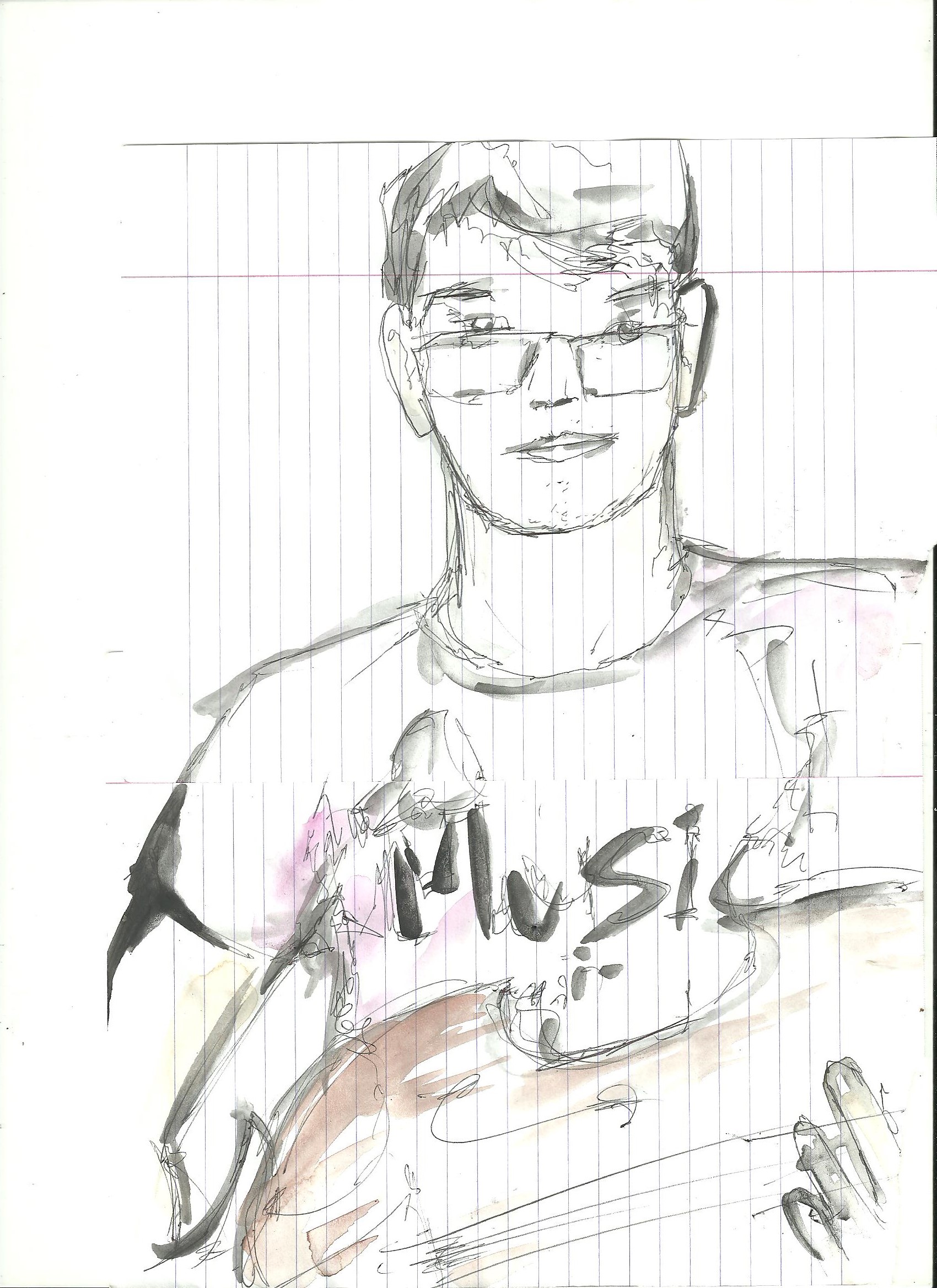
2. On the Union Square L platform, I ran into Larry and Sonia Wright drumming. (You should click that link by the way — the video will move anyone who’s seen him play). Just down the platform from them was a guy drawing portraits of riders. And right around him were Larry Wright’s sons, waiting to get on the train and dance.

Needless to say, I got my portrait done, there on the platform, surrounded by Larry Wright’s kids and by the sound of bucket drumming. It felt like home.

busking picture

Charges changed

During my July 25th arrest, I was given multiple reasons to leave the station, including “performing without a permit” and “performing on the platform.” Fortunately, both of these things are specifically permitted by the MTA Rules of Conduct. Oops! One officer also raised the idea of a “safety concern.” But, as he was unable to identify any such concern on video, his idea wouldn’t seem likely to hold water in court.

So, when I was released with my Desk Appearance Ticket, the charges listed were: “LOC000.00 0V.” Apparently the legal team needed more time at that point.

A search on WebCrims the next day returned nothing at all. Fortunately, Andrew Ramos at Pix11 was able to get an explanation from the police by phone: they had simply misspelled my name. So, as reported in his coverage, the charges were “blocking traffic.”

Well — it appears that someone has changed his or her mind yet again. According to a WebCrims search this afternoon, I am now charged with a violation of NY penal law statute § 240.35. Among other fun activities, this statute forbids:

  • “[remaining] in a public place for the purpose of gambling with cards, dice or other gambling paraphernalia,”
  • “[remaining] in a public place for the purpose of engaging, or soliciting another person to engage, in oral sexual conduct, anal sexual conduct or other sexual behavior of a deviate nature;” and
  • Congregating in a public place while “being masked or in any manner disguised by unusual or unnatural attire or facial alteration.”

I guess someone just doesn’t want us to have any fun.

Anyway, they got more specific with me, focusing on section 6:

“Loiters or remains in any transportation facility, unless specifically authorized to do so, for the purpose of soliciting or engaging in any business, trade or commercial transactions involving the sale of merchandise or services, or for the purpose of entertaining persons by singing, dancing or playing any musical instrument.”

Never mind that the MTA has its own section of state law addressing what one can and cannot do in the transit system — the NYPD has found a better one. And it’s only 80 kajillion years old!

Nonetheless, it would appear to make an ironclad case against me. Wait, what’s that you say, English teachers? Subordinating conjunctions, you say? Ah yes, let’s reread:

“Unless specifically authorized to do so.”

Aha! Well, given that this business is specifically addressed in 22 NYCRR / the Rules of Conduct in the first place, it looks like we’re alright. Thanks, justice system: you done me a solid.

Police and police reform: How I didn’t get shot

You might have noticed that we talk a lot about the police around here. As a matter of fact, we’ve even been wrongfully arrested a few times; and we wish to heck that the police would do things differently. So, many people conclude, we must also be an inherently anti-police organization.

And precisely that isn’t true. Everyone working on this project is a city resident, and we know why it’s important, particularly in low-income communities, that residents be protected. Academically, I also know that Michelle Alexander, whose work focuses on police and justice system reform, strongly defends the fundamental mission of police in urban communities, writing so early in The New Jim Crow. Because of all that, in a phrase bound to shock you all, we’ll say this: BuskNY supports the police just as much as we support police reform.

I imagine eyebrows are being raised about that claim, and so I’ll add a little story. On a Friday evening two and a half weeks ago, when I was walking back to the apartment after teaching, I heard gunshots behind me just as I reached my block. I turned around, and lo and behold: on the opposite corner of the street was a guy firing a 9mm down the neighboring avenue. I ducked behind a car’s engine block and waited.

Fortunately, when you live in a city, you’re not powerless. I called 911, and after a few seconds, I ducked out and moved up to the corner to see where the shooter was headed. When a police cruiser arrived with a minute, I hopped in. We drove a block and a half, I saw the guy who’d been shooting, pointed him out, and the officers stopped him. He’s now facing multiple charges, and I’m a grand jury witness.

I think this story is instructive for two reasons. First, it shows that the police keep communities safe, in this case by arresting a guy for shooting next to a school. Second, it shows that the police depend on their communities. In order to make that arrest, the police needed information from me. And that’s not an exception but a rule: police need community support to make arrests and to conduct investigations. And we won’t even get into the importance of trust and respect to calm down dangerous and violent situations. (How does a police force handle a disturbance when it’s broadly hated? Can that ever end well? And can we imagine it ending well when a police force is broadly liked and respected?)

So when a police department is routinely disrespectful, routinely uses excessive force, and routinely expresses a overt lack of interest in the law it is supposed to defend, that will impair its effectiveness.

My story from a few weeks back has one more chapter. I got out of the police car once the officers had handcuffed the shooter. That’s when backup arrived. As I watched, they stopped three young men walking down the sidewalk from a different direction. They held them against a wall and searched them, finding nothing. Another man came up, unaware of the shooting, and asked why the police had searched and released them. An officer, whose name I don’t know, walked up and shouted:

GET OUT OF HERE, YOU CAN SUCK MY DICK.

The man left. I pretended not to hear. Within a few minutes, the police took the shooter back to the 83rd Precinct, and I accompanied them to make a written statement. While I was writing the statement, in an area of the stationhouse office routinely used for guests, I noticed the envelopes addressed to various officers that were hanging on the wall. Prominent among them was an enveloped labeled:

FOR JOEY RAMOS

IS GAY

I finished my statement. I pretended I didn’t notice.

What’s the moral of this story? Well, I wrote at the beginning of the post that I support the police, and I’ll write it again here. I’m glad that the police were there to arrest a man for committing a shooting.

But I’ll add this: I’m twenty-two. I’ve been hit by a police officer. I’ve seen police officers use disrespectful and homophobic language on multiple occasions. I live in a minority-majority area. My neighbors are racially profiled. I’ve seen police officers disregard the law. I’ve seen police officers arrest other musicians. I’ve seen police officers ignore the rules and tell me not to mention the rules. I’ve had police officers threaten me with violence. I’ve had police officers twist my handcuffs to hurt me. I’ve had cuts on my wrists from handcuffs, and cuts to my hips and elbows from being dragged. I’ve had cuts to my head from being thrown into a wall. And I also helped stop a crime two and a half weeks ago. I’m like every last person in this community: we are the people the police need. 

So if you ask me for the truth, the whole truth, and nothing but the truth (so help me God), then here it is:

I support the police and it is a daily challenge for me to do so. I support the police in spite of the police, in spite of the beatings, in spite of the racial profiling, and most of all in spite of the ongoing, callous, crude, and regrettable disrespect to all of us who live here.

Now, if you’ve never dealt with the police, I’m sure it’s easy to be for them. If you have, it gets harder. If you’re a musician, if you’re Black, if you’re sleeping on a train, if you’re walking down the sidewalk in the wrong place, if you’re Hispanic, or if you’re a faggot, then it becomes very hard, very hard indeed to support your police department wholeheartedly.

A police department that treats city residents poorly — whether by hitting them, by searching them without reason, or by admitting that it just doesn’t care about the rules — is not winning any respect. And more importantly, It’s not protecting city residents as well as it could. So even if you (you, NYPD! you, Raymond Kelly!), care solely about public safety and not at all about respect, or courtesy, or professionalism, or eliminating racism and homophobia, for public safety alone you should ask your police department not to publicly belittle, insult, or harass your public.

Does this all relate to BuskNY? Yes, it does. I said at the beginning that we support the police and that we support police reform. And how we do that is simple: we advocate for the police to know the subway rules concerning the most major form of non-transit use of the MTA, to speak respectfully to artists, and to see artists as community members ready to cooperate, not as enemies.

When we argue that musicians should carry the rules, that they shouldn’t give in to unrecorded coercive threats, and that yes, they should sue when their civil rights are violated, we don’t say it because we oppose the police. We say it because we believe that the police should be doing their work better. Though the NYPD does not, we believe they can do their work better; and though the NYPD does not, we want to hold them to a higher standard. Many jokes are made in this city about the motto “Courtesy, Professionalism, Respect,” but I find it’s a pretty good slogan. I even believe the police can live up to it one day.

What I say to you is: police reform doesn’t happen in a vacuum. It happens around specific issues and specific communities. So a movement that protects musicians and that stands up for the rules is fighting, incrementally, the same battle as any other police reform initiative. We want the police to work with our community, we want them to trust us, and we want to be able to trust them. We believe a police officer who’s willing to read a copy of the MTA rules is a better police officer than one who starts threatening, not just for musicians, but for everyone — including for the NYPD. And when the police learn that lesson, maybe they’ll have learned something greater: that working with the city, and respecting the city, is the better kind of policing.

BuskNY en español

El metro de Nueva York es un sitio para compartir no solamente el arte, sino la cultura también. Eso se nota tanto en el gran numero de idiomas que se oye en cada andén como en la diversidad de tradiciones musicales, incluso varios grupos mexicanos y andinos.

Por consiguiente, uno de los proyectos de BuskNY es facilitar acceso a información legal práctica para músicos y artistas que no hablan el inglés. Es particularmente importante notar que una proporción elevada de ellos han tenido problemas con la policía, muy a menudo sin justificación legal ninguna de la parte de la policía, todavía sin tener acceso a información exacta sobre sus derechos como artistas y la protección que ofrece la ley.

Aunque ya existen varias fuentes de información sobre la legalidad de la música y del arte en la MTA, incluso el guía de CityLore y las reglas oficiales del MTA, hasta ahora no ofrecen información en español. Por eso hemos creado una pagina en español para satisfacer las necesidades de esta comunidad. También se puede ponerse en contacto con nosotros directamente, incluso en español, para hacer una pregunta o pedir ayuda.

Esperamos que esta información les pueda servir, y que ¡sigan disfrutando de la mùsica!